How to Prepare Your Property for a New Concrete Driveway in Lafayette LA
Process Breakdown: Preparing your property for a new concrete driveway in Lafayette requires careful demolition, drainage correction, clay-soil stabilization, base compaction, and utility planning before pour day. When these groundwork steps are handled correctly, the driveway gains the support it needs to resist cracking, settling, and long-term water damage.
If you want a concrete driveway that still looks solid 15 years from now, the prep work matters more than the pour day. When it comes to concrete driveway installation services in Lafayette, proper planning and groundwork make all the difference. In South Louisiana, heat, rain, drainage pressure, and shifting clay-heavy soils can ruin even a high-strength mix when the property is not properly prepared first.
Homeowners often spend too much time choosing finish styles and not enough time thinking about access, grading, drainage, and subgrade stability. Based on what we’ve seen across Lafayette, Youngsville, and Baton Rouge, the properties with the longest-lasting driveways are almost always the ones prepared correctly before the first truck arrives.
Start with Access and Demolition Planning
Before new concrete can go in, the site has to be cleared for the full driveway footprint and the equipment needed to build it correctly.
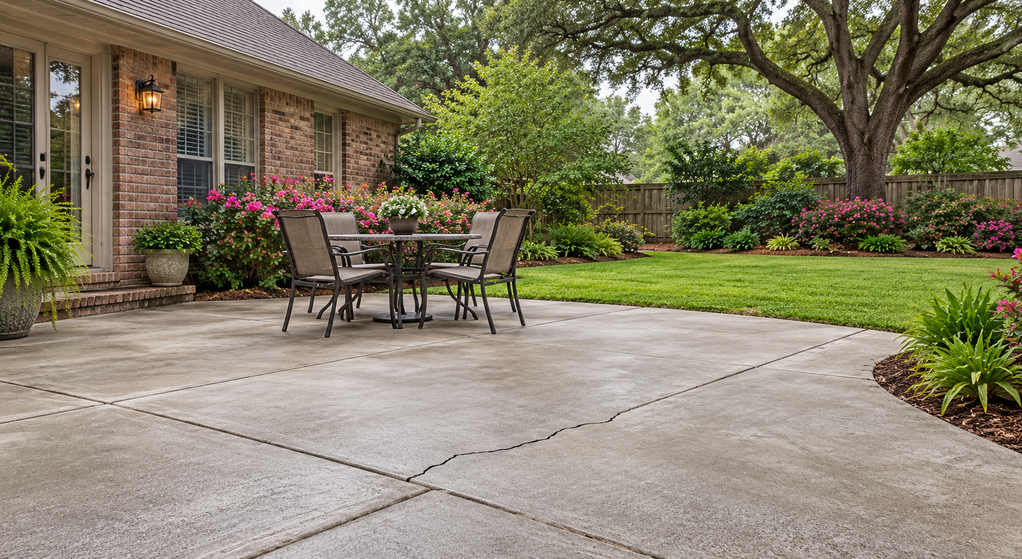
That means removing old concrete, asphalt, pavers, root systems, weak soil pockets, and any landscaping that interferes with edge forms or machine access. One of the most common mistakes homeowners make is leaving partial remnants of old surfaces near the garage apron or driveway edges. Those leftover weak zones often become crack points later.
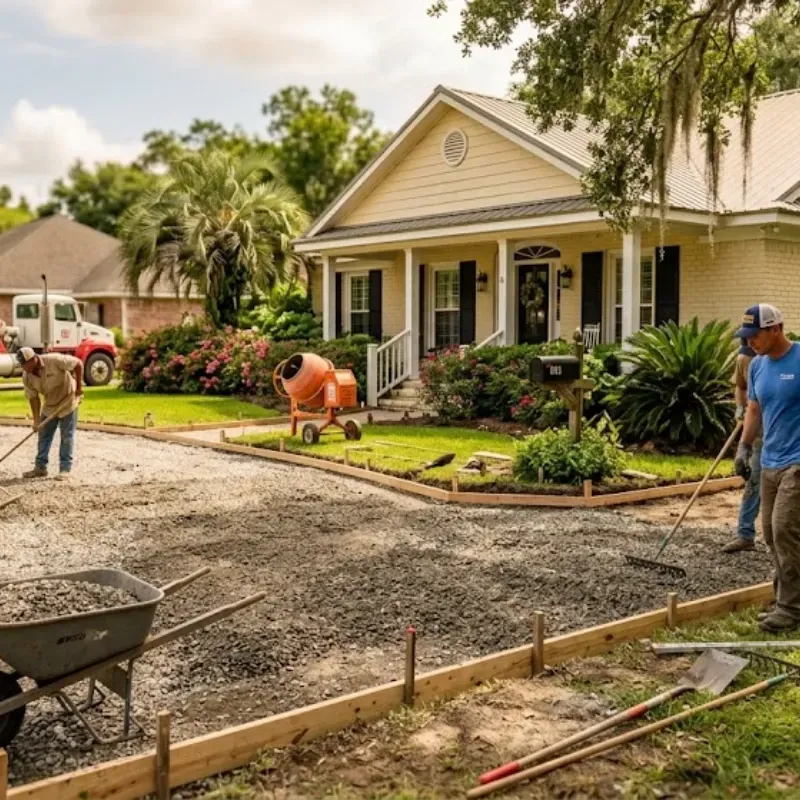
Our concrete driveway experts have seen perfectly good concrete mixes fail early because the new slab was poured against unstable leftover material instead of a clean, uniformly prepared base.
For Lafayette homes, access planning also matters because many older neighborhoods have narrower side clearances, mature oak roots, and drainage swales near the street. These conditions change how excavation and base compaction should be sequenced.
Address Drainage Before You Think About Concrete
Lafayette’s rainfall patterns are unforgiving. If water has nowhere to go, it will eventually attack the driveway from underneath.
This is why the property should be graded before the slab layout is finalized. Surface runoff must move away from the home, garage threshold, and neighboring lots without creating standing water along the driveway edges.
A slight slope is usually necessary, but the exact pitch depends on lot elevation, street crown, and where existing drains or culverts sit.
The tradeoff here is simple: too little slope traps water, while too much slope creates usability issues and can make vehicles scrape at transitions. A smarter decision is to balance drainage performance with daily drivability, especially for sloped approaches common in some Lafayette subdivisions.
Prepare the Soil for Lafayette’s Clay Conditions
This is where most driveway failures truly begin.
Large parts of Lafayette and surrounding Acadiana deal with clay-rich soils that expand when saturated and shrink during dry periods. That movement creates voids, slab stress, and eventually cracking.
The smartest preparation step is to excavate down to stable material, remove soft zones, and rebuild the base with properly compacted aggregate layers. If the existing soil is highly reactive, stabilization may also be necessary.
Many cheaper jobs skip deep enough excavation because surface soil can “look” firm. That shortcut usually shows up later as sinking tire paths near the garage or depressions where water collects.
A one-sided opinion from years in the field: if your contractor talks more about decorative finish options than soil preparation in Lafayette, priorities are in the wrong place.

Build a Proper Base Before the Pour
The base layer is the real foundation of the driveway, not the concrete itself.
A properly prepared base should be compacted in lifts, checked for uniform density, and thick enough for expected vehicle loads. This becomes even more important if you own heavier SUVs, work trucks, trailers, or service vans.
We personally prefer a crushed stone base with strong compaction over rushed fill dirt solutions because it manages load transfer and moisture better over time.
This is also where property preparation includes edge retention. Grass edges, flower beds, and loose shoulder soil beside the future slab should be contained so the slab edges do not become unsupported later.
Poor edge support is one of the most overlooked reasons residential driveway corners begin breaking apart.
Protect Utilities, Irrigation, and Tree Roots
A new driveway changes how weight and moisture move across your front yard.
Before excavation begins, identify sprinkler lines, drainage pipes, gas lines, cleanouts, and low utility crossings. These should either be rerouted, sleeved, or clearly marked so they do not get crushed during prep.
Tree roots are especially important in Lafayette, where mature shade trees are common and highly valued.
Cutting major roots without a plan can destabilize both the driveway and the tree. Leaving large roots directly beneath the slab creates uplift pressure later. The right preparation approach is selective root management combined with adjusted driveway layout when necessary.
This is why experience matters. The goal is not just making the slab fit, but making sure the property still functions years later.
Plan for Thickness, Reinforcement, and Use
Property preparation should match how the driveway will actually be used.
If the slab will support standard passenger vehicles, the prep may differ from a home that regularly receives delivery vans, RVs, or work trailers. Reinforcement layout, slab thickness, and joint placement all depend on real-world use.
We always guide property owners toward making decisions based on vehicle load, turning movements, and drainage exposure instead of visual preferences alone.
That smarter upfront planning prevents expensive breakouts and re-pours later. Review common cracking issues with concrete driveways to prevent them from worsening and leading to expensive repairs.
Final Walkthrough Before Pour Day
Before concrete trucks are scheduled, walk the property and confirm:
- Final drainage slope away from structures
- Stable and compacted base
- Utility conflicts resolved
- Forms aligned with garage and street elevations
- Tree and landscape protection complete
- Access path clear for trucks and finishing crews
This last inspection is your confidence checkpoint. If these items are right, the concrete has a fair chance to perform the way it should.

Once your concrete driveway is installed, the next thing to understand is how to maintain it. Review concrete driveway maintenance tips in Lafayette.
The Bottom-Line Takeaway
The best concrete driveways in Lafayette are built before the concrete ever arrives. Proper excavation, drainage correction, clay-soil prep, and load-aware base construction are what separate a driveway that lasts from one that starts cracking in two rainy seasons.
The smartest next step is to evaluate your property like a foundation system, not a cosmetic upgrade. Once the ground conditions, slope, and support are right for Lafayette’s environment, the finished driveway becomes far more reliable, durable, and worth the investment.

Written By:
Kurt Manalastas
Home & Property Research Journalist
Kurt is a Home & Property Research Journalist who researches and writes educational content on home services, property improvement, and residential decision-making. He focuses on translating real-world contractor experience, industry standards, and verified research into clear, practical guidance that helps homeowners understand their options and make informed decisions.