Accessibility & Slope Guidelines for Driveway Construction in Lafayette, LA
Key Insight:
Driveway slope in Lafayette is not just a design preference — it directly affects drainage performance, accessibility, vehicle clearance, and long-term concrete durability. Getting the grade right from the start requires understanding local rainfall patterns, ADA considerations, and how Louisiana’s expansive clay soil interacts with surface water over time.
Most homeowners do not think about driveway slope until it causes a visible problem. Water is pooling at the garage door. A low-clearance vehicle is scraping at the apron. A wheelchair or mobility device that struggles to navigate a transition that seemed manageable on paper. These issues often appear only after the concrete is poured and cured, when fixing them becomes expensive and disruptive.
In Lafayette specifically, slope and drainage design are more consequential than they are in many other parts of the country. The city averages significant annual rainfall, the terrain is relatively flat, and the clay-heavy soil does not drain naturally the way sandier soils do. A driveway that is designed without careful attention to how water moves across and away from it will have water management problems, and in Louisiana’s rainfall environment, those problems compound quickly. Here is what Lafayette homeowners need to know before the forms go down.
Why Slope Matters More in Lafayette Than Most Places
In a wet climate, a driveway that is too flat is more likely to hold water and develop long-term performance issues. A driveway surface that does not have adequate slope to move water off it quickly will pool, and pooled water on a concrete surface does several things that all lead in the same direction. It works into cracks and joints, it saturates the subbase, it promotes the growth of algae and moss that reduce traction, and in Lafayette’s clay soil conditions, it accelerates the subbase movement that leads to slab cracking. The drainage performance of a driveway starts with the grade built into it at construction. For homeowners planning a
concrete driveway in Lafayette, LA, slope is one of the design decisions that deserves the same attention as thickness and reinforcement — because it affects both how the driveway performs on day one and how it holds up over the following decades.
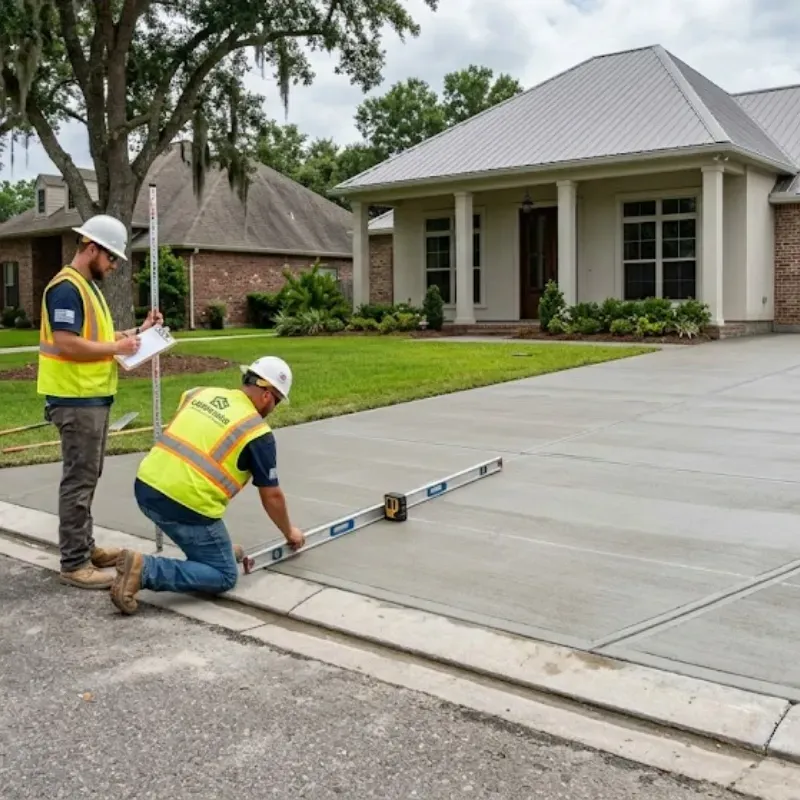
The standard minimum slope for a residential driveway surface is one percent — roughly one inch of fall per eight feet of horizontal run. That is enough to move water off a surface in moderate rainfall conditions. In Lafayette, where rainfall intensity during storm events can be significantly higher than the national average, a slope of one and a half to two percent is a more defensible target for driveways on flat lots. The additional fall moves water off the surface faster, reducing the duration of ponding during heavy rain and reducing the cumulative moisture exposure that the subbase experiences over time.
Cross-Slope vs. Centerline Slope: Understanding the Options
There are two basic ways to build slope into a driveway: cross-slope and centerline slope. Cross-slope runs perpendicular to the direction of travel, tilting the entire driveway surface to one side so water runs off the edge. Centerline slope, sometimes called a crowned profile, raises the center of the driveway and slopes both edges downward, shedding water to both sides.
Cross-slope is the simpler option and works well for narrower driveways where the grade difference from one side to the other is manageable. For a standard two-car driveway width of 20 feet, a two percent cross-slope produces a four-inch elevation difference from the high side to the low side — noticeable but acceptable. For wider driveways, that elevation difference becomes more pronounced and can affect vehicle comfort and accessibility for mobility devices if the cross-slope is too steep.
Crowned profiles work better on wider driveways because they limit the maximum grade experienced at any point on the surface. The crown runs down the centerline of the driveway, and each half slopes away from it at roughly one to two percent. The result is a surface that sheds water in both directions while keeping the overall grade at any individual point within a comfortable and accessible range.
Accessibility: What the Guidelines Actually Require
Accessibility requirements for residential driveways are less rigidly defined than those for commercial properties, but they are not absent, and for homeowners who use wheelchairs, walkers, or other mobility devices, or who anticipate needing that accommodation in the future, designing with accessibility in mind from the start is significantly less expensive than retrofitting later.
The ADA does not directly regulate private residential driveways, but its guidelines provide a practical reference for what constitutes an accessible slope. The ADA recommends a maximum running slope of 8.33 percent (one in twelve) for accessible ramps, and a maximum cross-slope of two percent for accessible walking surfaces. Applying those principles to a residential driveway means targeting a cross-slope below two percent in areas where the driveway also functions as a pedestrian pathway, and designing any transition from the driveway apron to the public sidewalk to meet the running slope limits that make it navigable without assistance.
The transition at the garage threshold is frequently the most challenging accessibility point in a residential driveway. If the garage floor is significantly higher than the driveway apron, the approach slope required to span that difference can exceed comfortable and accessible limits. Planning the garage floor elevation and the driveway profile together from the design stage — rather than treating them as separate decisions — is how that problem gets avoided. At
Lafayette Concrete Services, we work through these elevation relationships with homeowners before any concrete is placed, because the time to solve a grade conflict is in the design conversation, not after the forms are set.
Vehicle Clearance: The Practical Side of Slope
Slope also affects how vehicles navigate the driveway, and specifically, whether low-clearance vehicles can enter and exit without scraping. The transition point where the street meets the driveway apron and the point where the driveway meets the garage floor are the two locations where grade changes are most concentrated and where clearance problems most often occur.
At the street-to-apron transition, a steep break in slope — where the relatively flat street surface meets a sharply rising driveway — creates an angle that causes the front bumper or rocker panels of low-clearance vehicles to contact the ground. The solution is a gradual transition that spreads the grade change over a longer horizontal distance. Designing the apron with a concave profile that eases into the driveway slope, rather than an abrupt change in grade, accommodates a wider range of vehicles without scraping.
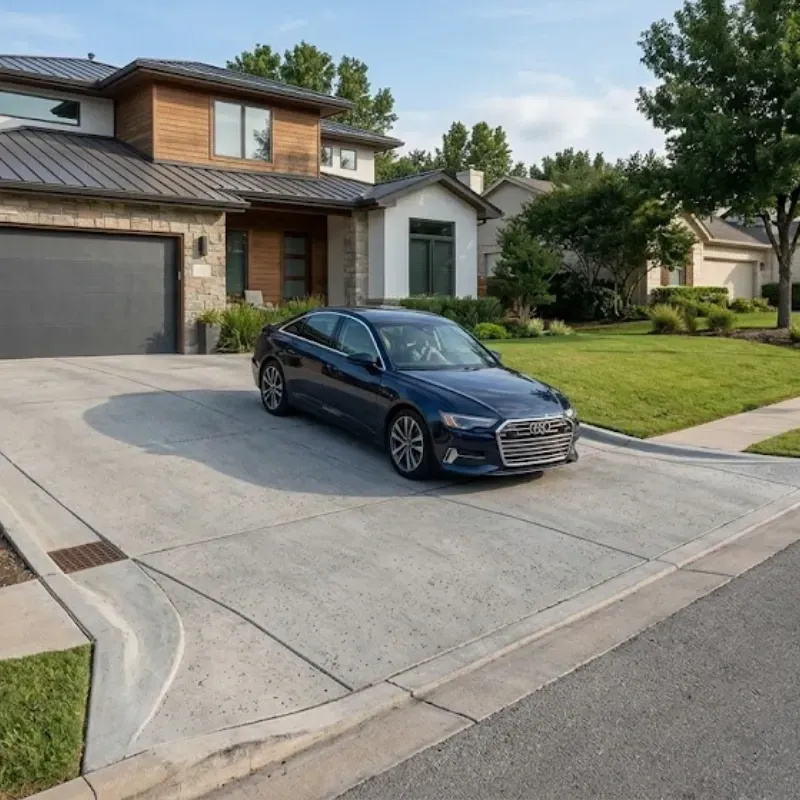
At the garage threshold, a convex transition — where the driveway slope meets the flat garage floor — creates the opposite problem: the rear undercarriage of a low-clearance vehicle can contact the high point of the transition. The standard approach is to flatten the driveway grade over the last several feet before the garage door opening, creating a landing area that reduces the sharpness of the grade change and gives the vehicle geometry more room to navigate the transition comfortably.
Drainage Direction and the Surrounding Property
A driveway must be designed around the surrounding property, not as an isolated surface. The slope designed into it determines where water goes when it leaves the surface, and where it goes matters for the surrounding property, the neighbors, and in some cases, the public right of way. In Lafayette, where lots are relatively flat, and drainage easements and swales are common features of residential neighborhoods, directing driveway runoff appropriately requires understanding the drainage infrastructure that already exists on and around the property.
Water directed off the side of a driveway should have somewhere to go that does not create problems. If it runs across a lawn and into a drainage swale, that is generally fine. If it runs directly onto a neighbor’s property, pools against a foundation, or flows into the street in a way that creates a hazard, it is not. In some Lafayette neighborhoods, the drainage patterns established by the subdivision infrastructure dictate which direction driveway runoff should flow, and designing against those patterns can create compliance issues or practical drainage problems that require correction.
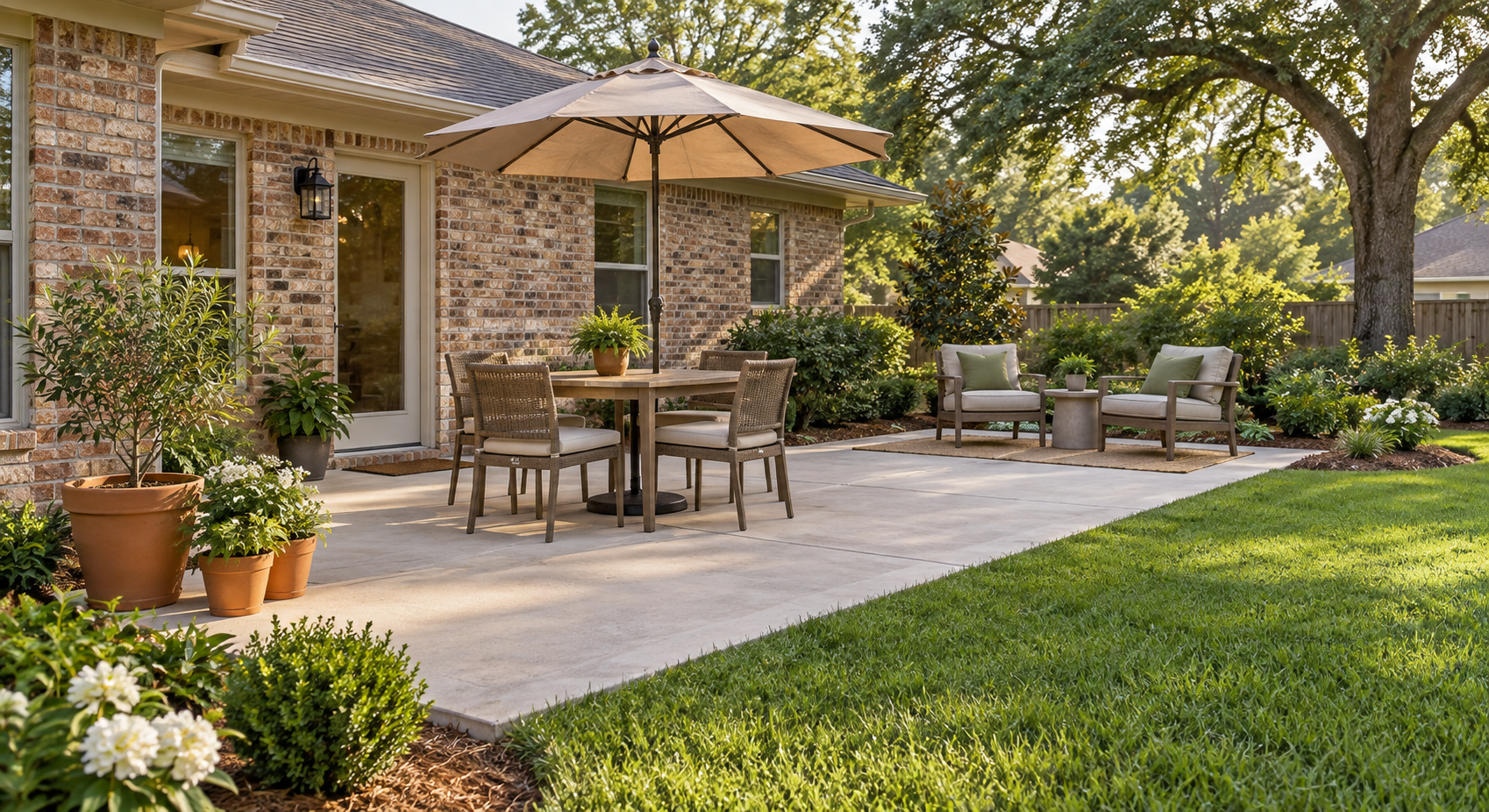
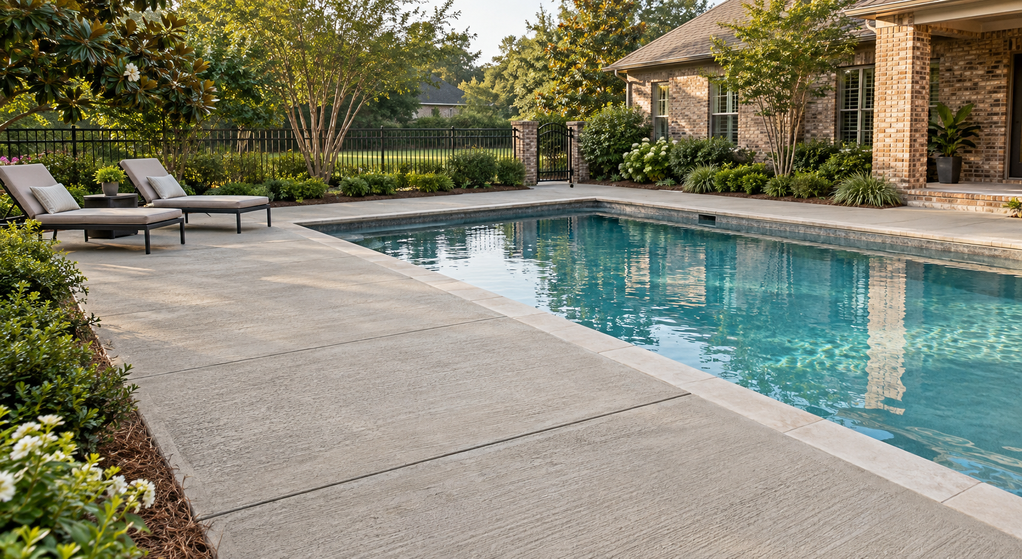
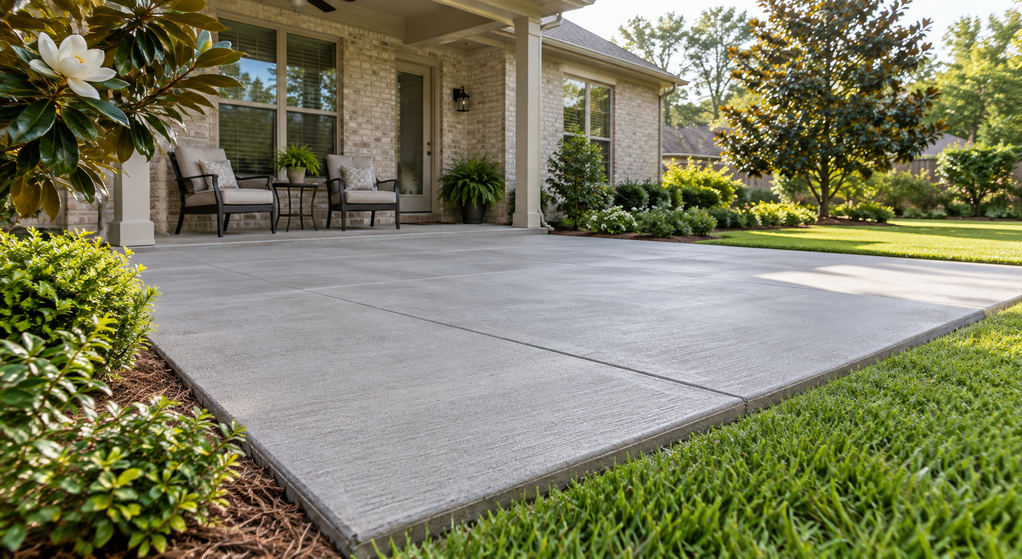
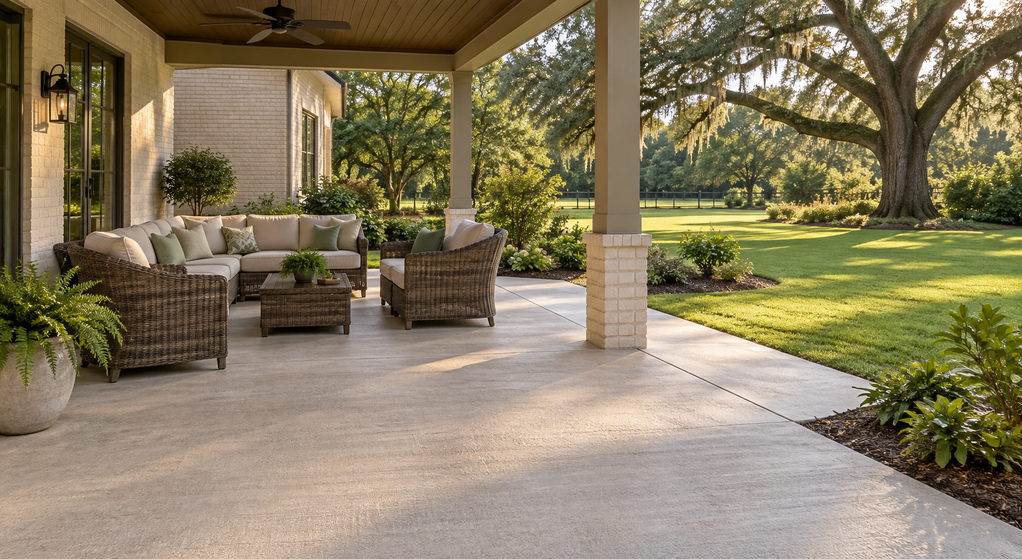
For properties where the driveway is part of a larger hardscape project, coordinating the slope and drainage design across all the concrete surfaces — driveway, patio, walkways — produces a more coherent result than designing each one independently. Our concrete patio services in Lafayette are frequently paired with driveway projects for exactly this reason, and addressing the drainage relationship between the two surfaces at the design stage prevents the kind of water management conflicts that are harder to solve after both are poured.
Common Slope Mistakes and How to Avoid Them
The most frequent slope mistake in Lafayette driveway construction is insufficient grade on flat lots — building to the minimum one percent slope when the site conditions and rainfall exposure justify more. The result is a driveway that technically meets the standard but pools water in heavy rain and experiences more subbase saturation than a steeper slope would allow. On a flat lot in south Louisiana, designing for one and a half to two percent wherever the surrounding grades allow it is the more conservative and durable approach.
The second most common mistake is abrupt grade transitions at the apron and garage threshold. Both transitions should be gradual — designed with the vehicle geometry in mind, not just the elevation difference that needs to be spanned. A contractor who has installed driveways in this area and is familiar with the clearance requirements of typical Louisiana vehicles — including the large trucks and SUVs that are common throughout Acadiana — will design these transitions correctly without being asked. One who is not familiar with the local context may produce a technically compliant driveway that still scrapes vehicles on a regular basis.
When an existing driveway is already being evaluated for repair or replacement, slope correction is sometimes the reason repair is not sufficient, particularly when the driveway has settled unevenly and now drains toward the garage rather than away from it. For homeowners deciding whether slope correction is possible through repair or requires a fresh pour, reviewing driveway repair or replacement in Lafayette can help clarify the better long-term option.

Written By:
Domenique Bomediano
Home Improvement Research Specialist
Domenique Jose Bomediano specializes in researching and creating educational content on home renovation, construction, concrete work, and property improvement. His work focuses on simplifying technical topics, contractor insights, and industry standards into practical information that helps homeowners better understand projects, costs, and long-term property decisions.